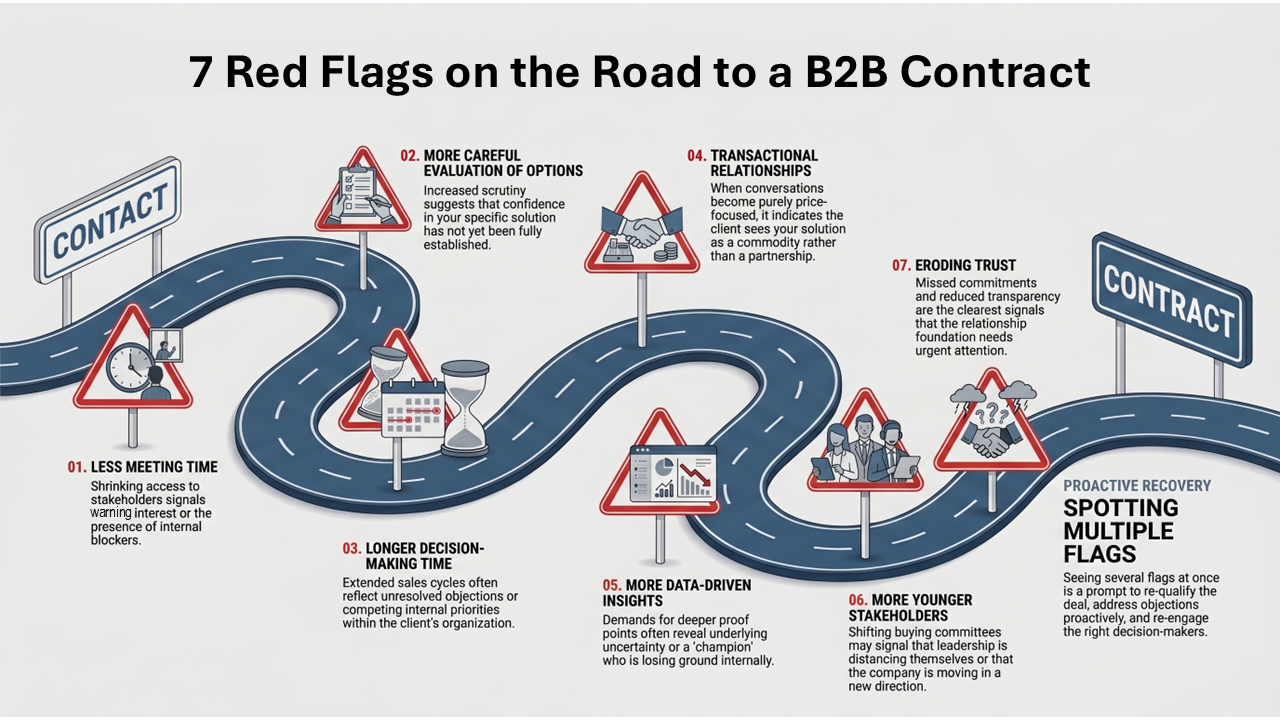
7 Red Flags on the Road to a B2B Contract
● B2B Sales Intelligence
Most B2B sales teams only recognise deal risk when it is already too late — when the prospect goes quiet, the decision gets deferred, or the contract lands with a competitor. By then, the signals were visible for weeks. They just weren't being read.
The following seven warning signs are patterns that surface repeatedly across complex sales cycles. Spotting them early is the difference between rescuing a deal and losing it.
The Seven Warning Signals
01
Less Meeting Time
When stakeholders start shortening sessions, cancelling calls, or delegating to more junior contacts, it almost always means your deal has dropped in their internal priority stack.
What to doReframe the value conversation at the executive level. Ask your champion directly: "What's changed in your priorities?" The answer will tell you everything.
02
More Careful Evaluation of Options
Requests to revisit your proposal, compare feature sets, or run a second RFP round signal that confidence in your solution hasn't fully landed. The client is still shopping — mentally, if not literally.
What to doDon't respond defensively with more collateral. Ask what is driving the re-evaluation. Understanding the underlying concern — cost, risk, internal pressure — is the only way to address it.
03
Longer Decision-making Time
Extended timelines rarely reflect process delays. They usually reflect an unresolved objection that nobody has named out loud, or competing internal priorities that have pushed your deal down the queue.
What to doTie the decision to a business outcome with a timeline the client already cares about. Their response will reveal how real the urgency is on their side.
04
Transactional Relationships
When every conversation gravitates toward price, discounts, or contract terms, the client is signalling that they see you as a commodity. Strategic partners don't negotiate from the first slide — they co-create outcomes.
What to doShift the conversation back to outcomes and ROI before re-engaging on pricing. If you can't articulate measurable value beyond the fee, neither can your champion when defending the budget internally.
05
More Data-driven Insights
Escalating requests for case studies, ROI models, and proof points signal that your champion is losing ground internally. They are being asked to justify the decision upward — and they need ammunition.
What to doEquip your champion rather than just responding to requests. Ask: "Who else is scrutinising this decision and what do they need to feel confident?" Then build that case jointly.
06
More Younger Stakeholders
A buying committee that suddenly includes more junior or unfamiliar faces may mean the organisation is democratising the decision — or that senior leadership is distancing itself and delegating down.
What to doMap the new stakeholders quickly. Understand their concerns, which often differ from leadership's. Maintain your executive relationship — don't let the deal become purely operational before it's won.
07
Eroding Trust
This is the most serious flag. It shows up as missed commitments, goalposts that keep shifting, or a gradual withdrawal of transparency about what's really happening internally.
What to doName it directly, not accusatorially. "I want to make sure we're still aligned — can we take 20 minutes to reset?" A candid conversation beats letting misalignment compound until the deal collapses quietly.
What to Do When You See Multiple Flags
A single red flag warrants attention. Two or more in the same deal is a prompt for serious re-evaluation: Is this deal genuinely winnable? Do we have the right contacts? What would need to change for this to close?
The teams that consistently outperform don't just have better products or lower prices. They read the room earlier, ask better questions, and adjust their approach before it's too late.
Seeing these signals in your pipeline?
Book a consultation with SkillsMastery. We help B2B sales leaders identify deal risk early and build the skills to respond effectively.
Book a Consultation →