
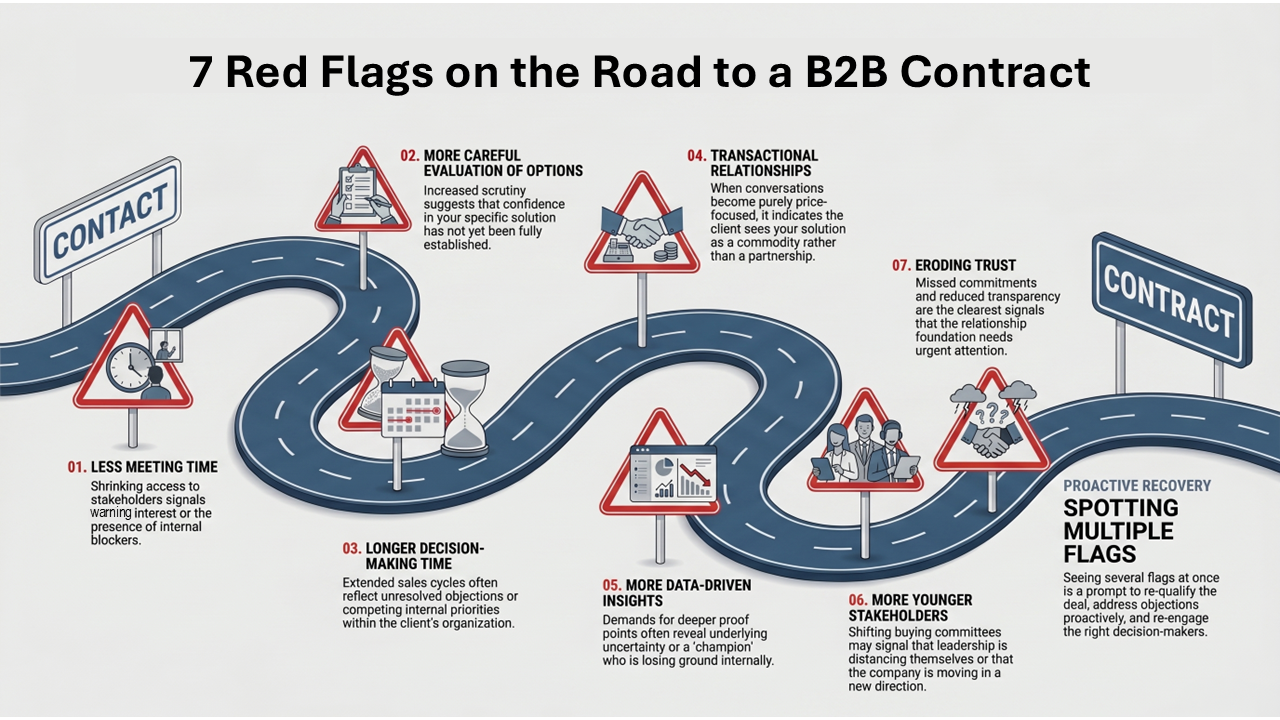
7 Red Flags on the Road to a B2B Contract
Most B2B sales teams only spot deal risk when it's too late. Here are seven warning signals to watch for — and what to do about each one.
Most B2B sales teams only recognise deal risk when it is already too late — when the prospect goes quiet, the decision gets deferred, or the contract lands with a competitor. By then, the signals were visible for weeks. They just weren't being read.
The following seven warning signs are patterns that surface repeatedly across complex sales cycles. Spotting them early is the difference between rescuing a deal and losing it.
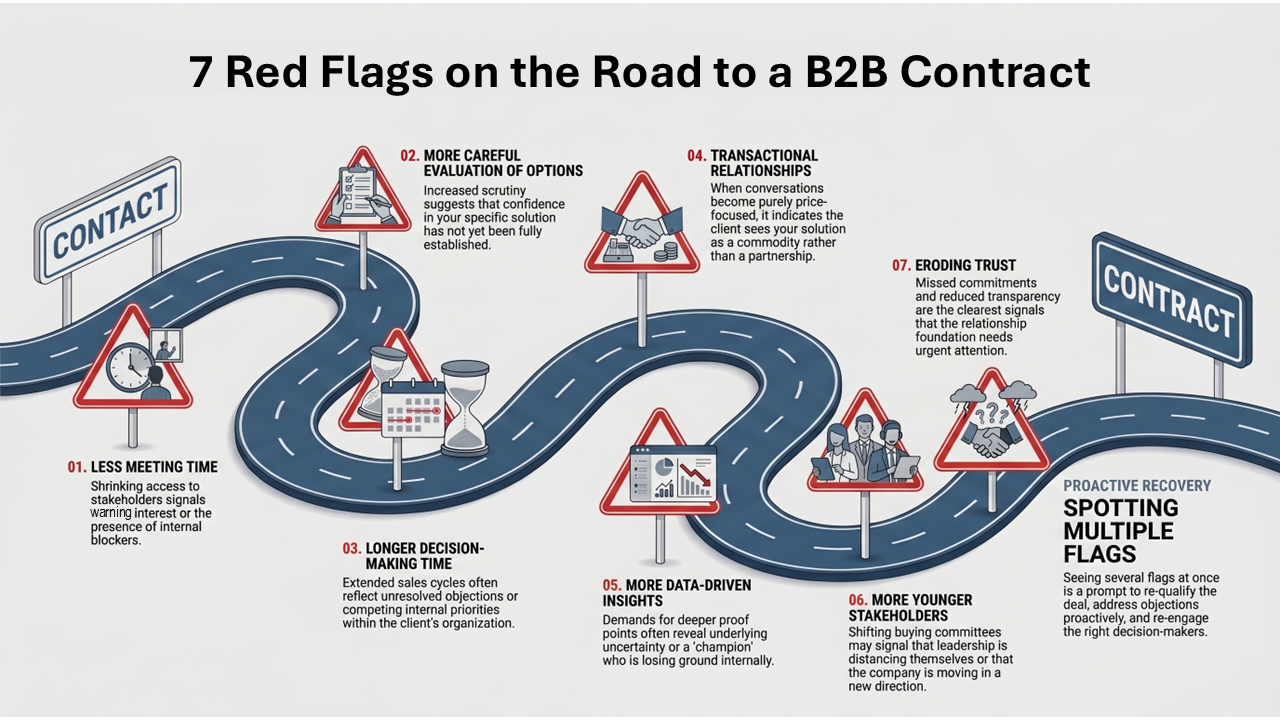
A single red flag warrants attention. Two or more in the same deal is a prompt for serious re-evaluation: Is this deal genuinely winnable? Do we have the right contacts? What would need to change for this to close?
The teams that consistently outperform don't just have better products or lower prices. They read the room earlier, ask better questions, and adjust their approach before it's too late.
Book a consultation with SkillsMastery. We help B2B sales leaders identify deal risk early and build the skills to respond effectively.
Book a Consultation →From Confidence to Contribution: The Journey Beyond Success

Confidence doesn't always arrive with a bold entrance. It builds quietly, step by step, as we show up for ourselves day after day. Every time you take action despite your self-doubts, you reinforce one belief: "I am capable". Confidence isn't about having all the answers. It is about trusting that you can figure it out along the way.
Having said that, lately, through a program called Beyond Success, I have been reflecting on something deeper.
There comes a moment in every person's growth journey when personal confidence is no longer enough, when achieving for yourself starts to feel hollow, when you realise the goal was never just about you. John Maxwell calls it the Law of Significance: "One is too small a number to achieve greatness." For years, I thought confidence was the destination - show up, take action, build belief, repeat. And it is. But only halfway.
Read Full Article on LinkedIn → https://www.linkedin.com/pulse/from-confidence-contribution-journey-beyond-success-boon-piul-lim-s7lpf
From the Cosmos to the Deal: What SpaceX's Space Data Centres Mean for Your Enterprise Sales Strategy

SpaceX is transitioning from a launch services provider into a space-based infrastructure and compute giant.
In a newly released interview, Elon Musk and the Starlink team detailed a massive strategic pivot: launching AI Data Centers into orbit and scaling civilizational energy infrastructure.
For enterprise leaders tracking silicon manufacturing, AI infrastructure, and energy constraints, here are 3 critical strategic insights from the announcement:
Solving the AI Power Crisis in Orbit: SpaceX’s new AI1 Satellite is a high-density compute rack (benchmarked against Nvidia GB300/Reuben architectures) operating 600–800km above Earth. By bypassing complex communication antennas, the hardware focuses entirely on massive solar capture and radiating waste heat directly into the vacuum of space, offering a negligible 3-millisecond latency.
The "Terafab" Megafactory: A planned 100 million sq. ft. chip manufacturing facility (10x the size of Gigafactory Texas) aiming to scale space AI compute aggressively toward a terawatt.
The Kardashev Scale Leap: Moving from a civilization that consumes localized power to one that harnesses the sun's energy directly. A terawatt of orbital compute represents twice the current electricity consumption of the entire United States.
Read Full Article on LinkedIn → https://www.linkedin.com/pulse/from-cosmos-deal-what-spacexs-space-data-centres-mean-boon-piul-lim-ajetc